2015-11-22

Battle Report: Black Powder - Battle of the Clearing

This week I had the opportunity to finally field my newly painted Austrians on the table, facing my own French troops. So one dark evening me and a friend gathered to fight it out to see how should be the ruler of Bavaria for real!
This started out as a little scenario to represent the first clashes at Teugn-Hausen, but I wanted us to use some cavalry as well, so I threw away that idea and just went for it.

As all the miniatures was mine I made the armies as well, and since I was a bit short on commanders and cavalry on the Austrian side, they had some advisors from Britain brought in to fill the gaps.

This was also our first time to try out larger unit sizes. Before we had that one standard unit was three bases, a large four and small two and tiny one base. But this has the problem of not really looking as good as it could. And we do have access to a rather large table here. So we decided to try to up the sizes a bit.
So here a standard unit is four bases and a large is six, all other sizes are the same. So my Austrians went from having lots of large units to having just two. But I think the aesthetics are very good, and we were both really satisfied with it.

French Forces
·         Commander-in-Chief – SR 8
o   Marshal Maréchal Davout

·         Géneral de Brigade Lorencez - 4ème Division – SR 7
o   3 Battalions of Line Infantry (1 large)
o   1 Battalion of Light Infantry

·         Géneral de Brigade Gilly - 2ème Division – SR 7
o   3 Battalions of Line Infantry
o   1 Battalion of Light Infantry

·         Géneral de Brigade Petit - Cavalry Division – SR 7
o   2 Regiments of Dragoons
o   1 Regiment of Chasseurs á Cheval

Austrian Forces
·         Commander-in-Chief – SR 8
o   Feldmarschalleutnant Hobenzollern-Hechingen

·         Advance Guard: Feldmarschalleutnant Vukassovish – SR 8
o   1 Regiments of Kürassiere
o   2 Regiments of Hussars

·         Brigade Generalmajor Kayser – SR 7
o   3 Battalions of Line Infantry (1 large)
o   1 Battalion of Landwehr Volunteers
o   1 Battalion of Jägers

·         Brigade Generalmajor Bieber – SR 7
o   2 Battalions of Veteran Grenadiers (1 large)
o   1 Battalion of Line Infantry
o   1 Battalion of Jägers

I've been tinkering a bit with the stats on different Austrian units, taken inspiration form some blogs I've seen, and what I've read about them. But basicly the stats for all units are standard, but I've decided not to let any Line, Landwehr or Grenadier battalion form Mixed Order as they didn't think that skirmishing was something for the common soldier. The Jägers are more of a bleak copy of the British Rifles, without all the nice special rules they have. I'll do a more thorough accounting of my thoughts at a later date if there is some interests in it.

On to the battle!
I have to apologize of the photo quality, I used a different camera to take them than I normally do, and it didn't do well with low light...

The deployment of our troops, first out is the Austrians


The French that oppose them


And the whole battlefield in one blurry shot.

The first turn saw the French advance quickly up the field, but the Austrian right was just as quick, and lines was drawn. Some sporadic fire was exchanged between the Jägers and the French light troops.


Grenadiers form line in face of the French columns.

The Austrian left did not have the speed in their legs as the right, so they fell behind a bit, advancing slowly at the enemy.

Austrian landwehr was not that interested in moving and the unit with them was held back as well

During the second turn the french had a plan, to attack with force on the Austrian Grenadiers, but plans did not take form as was planed, and a total misunderstanding of the orders to charge led to the retreat of the two center battalions, leaving the left dangerously exposed.

But on the other side of the battlefield things took orders a bit better for the french and a valiant charge was made into the Austrians big unit there. The result however was not that good, and after two rounds of fighting they was destroyed as more Austrians moved up in support.


Overview of the battle after turn two

On the third turn our reserve cavalry arrived, and for the french this was not a moment too soon. And the first thing that happend was that the Casseurs charged my poor landwehr, that didn't even have time to form square and promptly took it in the face.

In the centre the orders was finally straightened out and the large unit plowed right into the Austrian grenadiers.

Other than that the French right stood its ground, continuing the fire exchange.

In the fighting something amazing happened, the landwehr somehow held of the cavalry, giving them a bloody nose and threw them back to their own lines. The Casseurs commander should have a stern talking to them...


The next round got only a single usable picture, as the chasseurs once again charge the landwehr, this time they form the square, and the line infantry jumped on the grenadiers right next to the landwehr, but was beaten back with a combination of good closing fire and some rather abysmal rolling on the french side. On the left the large units fought again, resulting in mostly nothing, and some fire exchange resulted in a few disordered units here and there, stopping most any order giving over there.

The came what would be the next to last turn as the french line started to crumble, first the Austrian grenadiers finally won the combat, and promptly a 3 was rolled for the French break test and the unit disappeared.

Next the Casseurs didn't receive any order and got stranded in the front of some rather angry Austrians, and was shot to bits.

Overall the french didn't get much done and failed everything.

On the last turn the Chasseurs got charged by a unit of Austrian Hussars, sealing the deal.

In the centre the Austrian Kürassiere got hold of a Dragoon unit, and destroyed it instantly, the firing also got a few of the French unit down to shaken and we could see no point in continuing and gave the Austrian army a great victory.


Overall it was a great game, and I hope to get my Austrians on the table soon again. There is also some Prussian units marching in the horizon, from my opponent of the day, but will they be on the allies side or the French...?

2015-11-18

Black Powder: Austrian - Landwehr

So as I got quite a few miniatures left over in my Landwehr box after I made my Jägers I put together a battalion of ordinary Landwehr as well. During the battles around Eggmühl there wasn't any Landwehr on the field in any of the battles. And as far as I can find there was no battalions at all in any of the Korps, but when we come to the battles of Aspern-Essing and Wagram there are some. So I took hold of that and I plan on adding a few units, if nothing else it's nice to have some really low quality troops around sometimes.

At Aspern-Essling the III Korps are noted to have two battalions of Landwehr, they aren't noted to have been part of the Korps at Teugn-Hausen, so they must have been picked up in the days following the battle somewhere. I have no idea of where they are from or if they made any combat contact at all at Aspern, if they even showed up for the battle, as far as I can tell, there seems to be a quite common occurrence that they more or less took their things and went home on the eve of battle.


I choose my colours from the Victrix box where this is named as "Austrian Landwehr", well if this is true or not is probably something for someone else to argue about, as they often had uniforms that they had either made themselves, or been made for them but in a color that was both available and took the fancy of their colonel at the time. So most likely not a single battalion had the same things as any other, and more than likely not even as themselves.


But light gray looks good next to the whites of the line and dark grey of the jägers so this is how they turned out.
I also gave them a flag, Landwehr often more or less stole old discarded flags from line regiments as they wasn't really allowed to have any, so I gave this battalion an old 1792 issue flag, I imagine that the raided some barracks of the local regiment and took what they found.

2015-11-14

Black Powder: Austrian - 6th Kürassiere Regiment

I've finished the first cavalry regiment for my Austrian army. This is the Gottesheim cuirassier regiment that was part of II Reserve Korps under Michael von Kienmayer, but during most of the 1809 campaign they was detached to I Reserve Korps instead.
As such they did not see much action during the early parts of the campaign, but they did see some serious action on the 22th april at Alteglofsheim and the cavalry battle there.


As the French drove the austrian army away from Eggmühl the austrian cavalry reserve made a stand at Alteglofsheim to hold the french cavalry back and allow the infantry to retreat in good order. On the Austrian side stood about 32 squadrons of cavalry, including the 1st and 6th Kürassiere regiments. On the french side there was over 60 squadrons arrayed, including four regiments of Cuirassiers and 2 regiments of Carabiniers, the french finest.


Even though they fought valiantly they was catastrophically outnumbered they made two charges into the french and then withdrew having delayed the french enough to allow the majority of the infantry to get away in the darkness. Giving Napoleon victory, but not a smashing one and could be said to be the very beginning of his downfall years down the road.


The miniatures then, they are actually made from french plastic heavy cavalry from the Perrys, I let them keep the backplate that the realy did not have. And changed heads to the helmeted infantry ones from Perrys austrian infantry box. I also trimmed away a lot of epaulets and extra fabric from the arms and neck that the French had, giving them the more simple look that the Austrian had.


Is it perfect, well no, there are a few things that are wrong with them, but they are good enough for my purposes and far cheaper and more accessible than the metals that are out there.

Thanks for this time, I'll have more to show you as soon as I can get some more writing time.

2015-10-29

Black Powder: Austrian - Grenadier Regiment Peccaduc

After a long time of no activity I've gotten time to finish of another unit. To mix things up I did a grenadier battalion. The battalion I choose was Peccaduc, this battalion has some conflicting information about it. From some sources they stood with Archduke Charles and I reserve corps at the small village of Grub during the battle of Teugn-Hausen, but then they seems to move with II reserve corps towards Abensberg. This might be for that this battalion is known under three different names, and it got changed during this time.

First the was commanded by Major August Picot de Beccaduc Baron Herzogenberg and known either as Peccaduc or as Beccadüc. Then after the battle of Abensberg they are known as Legrand. So, there is a possibility that this battalion did not stand as Grub, or they did, but got confused in the reports with another battalion that was with II reserve and marched of to do battle at Abensberg.

I've choosen to think that they did stand at Grub and then marched of to Abensberg, this just makes them seem more bad-ass, and that's what grenadiers do.

After they got hammered at Abensberg they withdrew too once again take to the field at Wagram, under FML Prochaska they formed part of the line between the villages of Süssenbrunn and Aderklaa and keeping Massena from breaking out with his cops there, also they was involved in the destruction of the great square, formed by the french army of Italy under the command of GD Macdonald.

As for the painting of this unit, I went for representing two of the regiments that makes up this battalion, namely the 55 and 56. Regiment no 9 was also in the mix, but as they had a green color as well I choose to just use the other two here. I also gave the unit the white Leibfahne that most regiments had one of, but here it differentiate them quite a lot from all other units, and that's always good on the tabletop.


2015-10-11

Tutorial: My way of basing

I've had a few questions come up over how I base my figures and what materials I use for them. So I thought that I could take a few shots when I base a unit and write up how I do it.

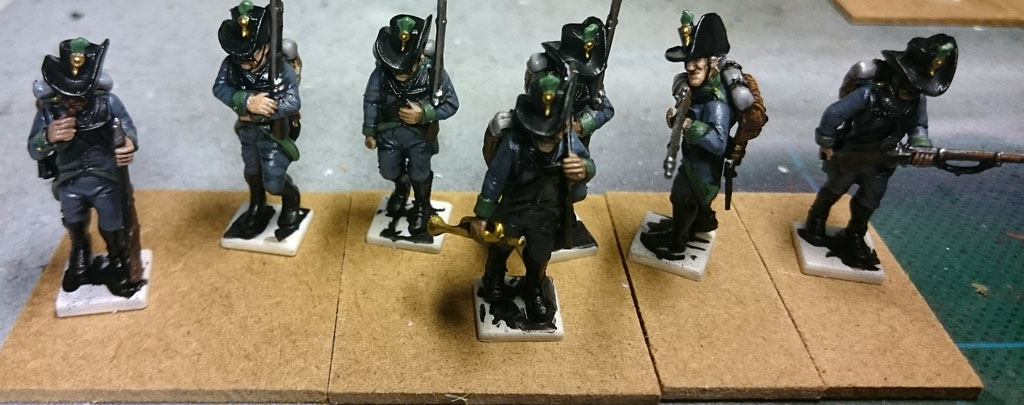
So, I'm going to use my Jägers for this little tutorial.

First up I "dry fit" the miniatures on the bases I'm going to use. For this, I used two 40x40mm bases and two 20x40mm bases, here I just makes sure that I can fit every miniature that I want and get the composition for them right.

The next step is putting in the ground, this I do by mixing filler, wood glue and a bit of brown paint, I usually use a mixture of about 4/2/1 here, but it's not that important just how you do it.
First I spread a 2-3mm layer of this stuff all over the base, then I press the miniatures into it, and lastly I take a old brush and spread it around to get some nice texture going and covering the bases so that the miniatures will set.
If I want rocks on the base I also place them here, just shove them into the mix and blend the mix around them so that they look like they are imbedded in the ground.

This then has to dry, usually I leave them overnight, but they mostly need 3-4 hours to dry though, and this next step is possible as soon as it's mostly set.
Here I just add some patches of cork, dab a bit of wood glue on the base and stick them in the cork container. I try to get some flow on the bases here, so that they fit together with the cork.

After yet another drying period its time to put down the first layer of paint, I use the same paint as I mixed with the filler, I use a craft paint I get at a local craft chain here in Sweden called Panduro, the colour is Burnt Umber and this paint is really thick, so I mix it with a lot of water and paint over everything, some times even over the rocks on the bases. Here it's important not to have such thick paint so that the texture from the cork disappears, but it ok to have it blend together a bit.

Next step is to paint the rocks, here I used a few grays I had close at hand, but I could also use the craft paint. I'm not that carefull when I drybrush it, as any spill will either be covered up, or just look like, you know, ground.

Then I drybrush the ground. I usually do this in two steps, first a 1/1 mix of the burnt umber craft paint with a bone colored craft paint, after this I do another go with just the bone colour. Here you can see the progression from base, one coat and two coats.

After this I put on some static grass, I cover everything that's not covered in the cork, and a few smaller patches in the cork, to break it up a little bit and shape the bare ground a bit.
The grass I use it Army Painters Steppe Grass, that I think has an excellent blend of colours.

And the last step is to add a few tufts of, well anything you want. Nowadays I mostly use small patches of flowers and bushes made out of clump foliage. But anything you like is right in this stage. This is just they way I do it on these miniatures, and I might do it some other way on some other army.
The flowers are from MiniNatur as you can see in the picture, I got mine from Antenocitisworkshop but I have also seen them at a local train shop here, so look around a bit if you want to have them as well.

And thats about it, if there is any other questions don hesitate to write a little line in the comment field, if you want to now something you can bet there is a few others that wants to know the same thing.